Water shortages and food waste

Today, droughts and water shortages are increasingly common. Climate change and the weather conditions it causes are significantly drying out our soils. Food production also plays a major role in the use of this precious resource, as we explain below.
What is a water shortage?
We speak of a shortage when the demand for water is greater than the availability in a region or country , and does not only concern domestic use but includes all sectors combined.
Today, underground reserves are sufficient to meet global demand, but their distribution is uneven. Water scarcity affects 700 million people across 43 countries worldwide. But by 2025, it will affect nearly 1.8 billion people, and almost 5.2 billion people (nearly two-thirds of the world's population) will be experiencing water stress.
The causes of the water shortage
Natural causes
Water shortages can be caused by natural factors:
- An absence of groundwater or watercourses in a region,
- Years of low rainfall.
Human-caused factors
- The significant development of hydraulic infrastructure
- The development of infrastructure linked to improving living standards
- use of water
- The expansion of irrigated areas
- Deforestation or intensive agriculture
- Pollution and global warming
Increased water consumption and unsustainable management
Among the causes mentioned previously, three main sectors rely on significant water consumption:
Domestic use accounts for only 10% of global freshwater resource use. Industrial use accounts for 20% and agriculture for 70%, with 90% of this water being non-renewable .
Moreover, according to the FAO, global water demand is expected to increase by 50% by 2050. This is due to population growth (and therefore increased food consumption), improved living standards, and climate change.
Food and its water footprint
What is a water footprint (or water footprint)?
The water footprint, or water footprint, is the total amount of water used to produce a good or service. This includes the water we use or waste directly or indirectly, often without realizing it. Several methods exist for calculating this footprint, but the most widely used remains that of the Water Footprint Network .
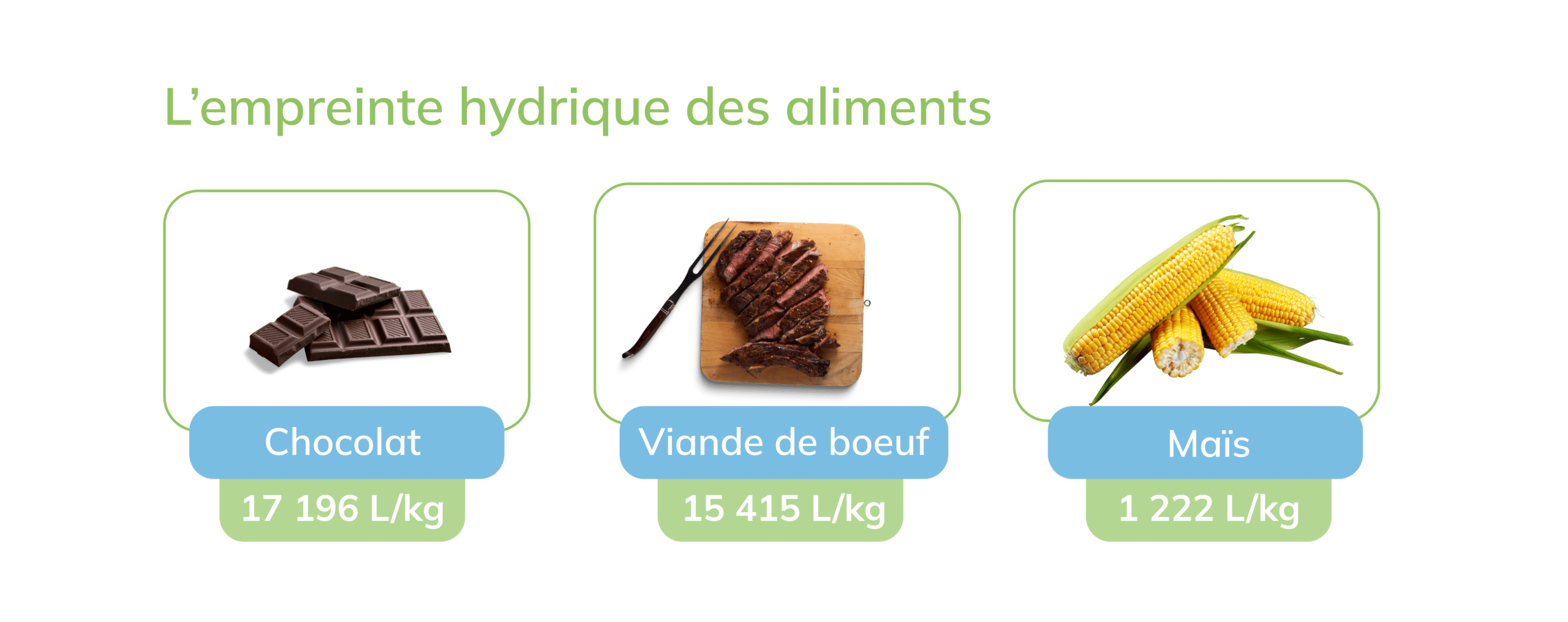
As a result, the foods we consume can have a high water footprint (or water footprint) depending on their type.
For example, 15,415 liters of water would be needed to produce 1kg of meat.
The same applies to chocolate, which, even though it is a product of plant origin, would require 17,196 liters of water per kg.
However, it is important to keep in mind that this food footprint varies from country to country and from one production method to another.
The impact of food waste on water scarcity
Sources: FAO , World Health Organization , un.org , ademe.fr , cieau.com , waterfootprint.org , Youmatter.world , latribune.fr.
FOR A BETTER FUTURE
Would you like to take action against food waste
Kikleo helps you reduce food waste and increase the performance of your restaurant by offering you a analysis of your losses using innovative technological tools.