From September 18 to October 8, 2026, the European Sustainable Development Week (ESDW) will highlightsustainable food. This is an opportunity to revisit a key lever: better understanding what we waste, in order to reduce it more effectively. Key figures, challenges for institutional catering, and concrete actions to implement—here's our overview.
The 2026 European Sustainable Development Week: concrete initiatives for sustainable food
The European Sustainable Development Week is a European event that highlights concrete initiatives each year in support of the Sustainable Development Goals. In 2026, it will take place from September 18 to October 8 and will placesustainable food at the heart of the mobilization, echoing the adoption of the National Food, Nutrition and Climate Strategy.
A theme that intersects four issues at once: environmental, health, social and economic. And among the initiatives encouraged by the organizers are workshops raising awareness about food waste.
Food waste in France: key figures
Indicator
Figure
Food waste in France
9.7 million tonnes (2023)
Part still edible
3.8 million tonnes
Share of global greenhouse gas emissions
8 to 10%
Full cost of food waste in institutional catering
2025: €1.03 per meal; 2016: €0.68 per meal
This last figure deserves closer attention: in less than ten years, the cost of food waste per meal has increased by more than 50%. ADEME (the French Agency for Ecological Transition) has observed this increase across all sectors: schools, healthcare, and businesses. In other words, taking action allows for better control of rising costs.
Why institutional catering is a major lever
With several billion meals served each year in France, institutional catering represents a considerable potential for reduction. There are three reasons for this:
The volumes are measurable. Food waste from a catering establishment can be weighed, categorized and tracked over time.
The causes are identifiable. Overproduction, unsuitable portions, unpopular menus, service organization: each cause calls for a different action.
The regulatory framework structures and accelerates the process. The EGALIM, AGEC and Garot laws already require diagnosis, donations and source separation for those involved in institutional catering.
Measure, analyze, reduce: the method that works
Sustainably reducing waste requires moving beyond estimation. The approach we observe with our clients consists of three steps:
Continuous measurement rather than manual diagnosis over a week: variations in menus, attendance and season can only be read over time.
Distinguish between the sources : food waste in the kitchen, surpluses during distribution, leftover food on plates. The levers used are not the same, and confusing them leads to action in the wrong place.
Share the results with the kitchen staff and guests. It's often by seeing your own figures that you can take action.
On the ground during the 2026 European Sustainable Development Week
During the week, our teams are alongside our clients in healthcare and business.
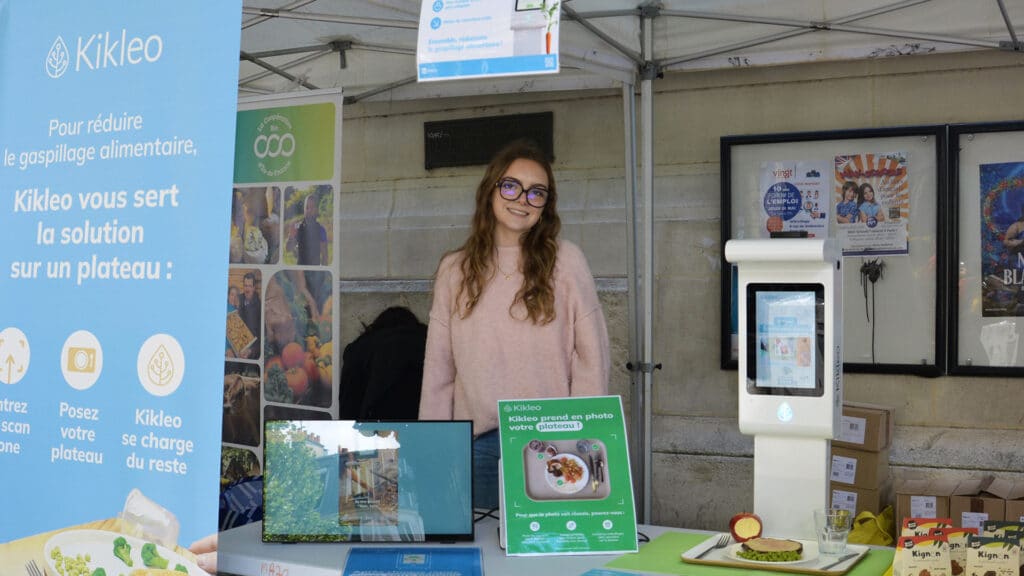
On our stands, we'll be offering questionnaires to help guests guess what's most wasted, a suggestion box to collect their ideas, and a "Guess the Weight" challenge to guess the weight of food and raise awareness about what's actually thrown away. Simple and fun formats that spark real change.
Thank you to our clients, their kitchen teams and their guests for their commitment.
5 actions to launch as soon as the new school year begins
Weigh and categorize leftovers for at least one complete menu cycle.
Adjust paper weights and production based on reliable data.
Displaying results in the dining room: raising awareness among guests contributes to lower volumes.
Involve the kitchen teams in reading the figures, every week.
Set a specific numerical goal and track its progress over time.
Conclusion
The European Sustainable Development Week (ESDW) is a useful starting point, provided we don't stop on October 8th. Food waste is one of the rare issues where environmental impact, budget, and diner satisfaction all move in the same direction. It all starts with reliable measurement.
Do you want to assess the impact of food waste in your restaurant?
To provide the best experiences, we use technologies like cookies to store and/or access device information. Consenting to these technologies will allow us to process data such as browsing behavior or unique IDs on this site. Not consenting or withdrawing consent, may adversely affect certain features and functions.
Functional
Always On
The technical storage or access is strictly necessary for the legitimate purpose of enabling the use of a specific service explicitly requested by the subscriber or user, or for the sole purpose of carrying out the transmission of a communication over an electronic communications network.
Preferences
The technical storage or access is necessary for the legitimate purpose of storing preferences that are not requested by the subscriber or user.
Statistics
The technical storage or access that is used exclusively for statistical purposes.The technical storage or access that is used exclusively for anonymous statistical purposes. Without a subpoena, voluntary compliance on the part of your Internet Service Provider, or additional records from a third party, information stored or retrieved for this purpose alone cannot usually be used to identify you.
Marketing
The technical storage or access is required to create user profiles to send advertising, or to track the user on a website or across several websites for similar marketing purposes.