School catering: how to reduce food waste?
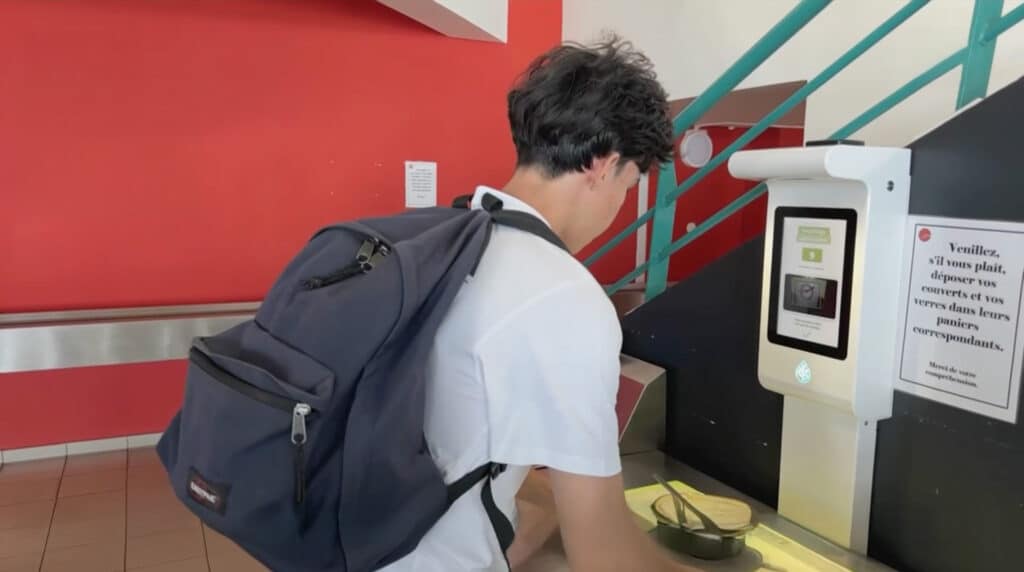
For local authorities, school catering has several imperatives: complying with regulations, controlling budgets, and improving meal quality. Reducing food waste in school cafeterias is therefore no longer simply an awareness campaign, but a genuine management tool, provided we know what is being thrown away, why it is being thrown away, and which actions actually work to reduce the amount of waste.
This is precisely where Kikleo comes in: by automating the measurement of food waste. The solution helps local authorities transform a regulatory obligation into a sustainable, measurable, and positive approach for their school cafeterias.
EGAlim, AGEC: what the law requires of local authorities
In school catering, local authorities must deal with several requirements from the EGAlim, AGEC and Climate and Resilience : diagnosing and reducing food waste, reaching responsible sourcing thresholds, diversifying menus and informing diners.
Regarding food waste, the AGEC law sets a target of a 50% reduction by 2025 compared to 2015 and mandates an assessment for all institutional food service establishments. However, the 2025 statistical report from "ma cantine" (my canteen) shows that only 67% of responding establishments had completed the assessment, and among those, 91% had implemented an action plan. Therefore, measurement is often the starting point for structuring action.
On the supply side, public institutional catering must reach 50% sustainable and high-quality products, including 20% organic. However, online-reported purchases for 2024 showed only 29.5% sustainable and high-quality products and 11.8% organic on average. Reducing food waste can therefore free up resources to invest in better quality, without solely focusing on increased costs.
Finally, a weekly vegetarian menu is mandatory, and institutions must inform diners and families about the quality of the meals. A common need emerges: access to objective data to explain the choices made and make progress visible.
Food waste in school cafeterias: a cost that often remains invisible
Catering accounts for approximately 3.8 billion meals served each year, with an average waste of 115 grams per meal per diner, across all establishments. Behind these grams lie discarded food items, but also labor, energy, and costs: the true cost of food waste far exceeds the purchase price of the food.
A one-off manual weighing gives an order of magnitude, but only regular and detailed data allows us to understand the specific reasons; whether the food waste comes from overproduction, an unsuitable weight, or a recipe that is not appreciated.
Kikleo: measuring food waste to take action in the right place
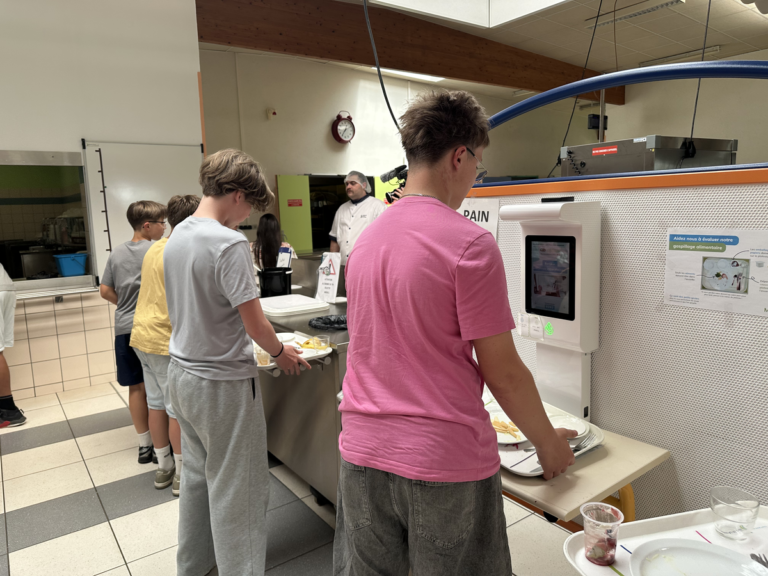
Kikleo combines 3D cameras and proprietary AI to automatically identify and quantify food waste, both in the dining area and the kitchen. The restaurant team gains access to metrics such as waste per diner, most frequently discarded foods, and associated costs and carbon footprint, consolidated across a single restaurant or multiple locations.
“Artificial intelligence has been designed to assess food waste without any wasted time, with an evaluation and prevention ecosystem created from scratch by the startup Kikleo. Imagine that with this system, equipped with a smart camera and installed at the tray clearing station, diners and kitchen staff know, in real time, exactly what has been wasted in terms of weight and then cost.”
– Guillaume Le Cantinier
This automation brings three major benefits:
- A reliable measurement, without relying solely on time-consuming manual weighing.
- An analysis over time, to compare periods and verify the effectiveness of actions.
- A reduction in food waste, thanks to our explanatory platform, useful to catering services, sustainable development departments and educational teams.
However, measurement is never an end in itself. The value of data lies in what it allows us to change on the ground.
From data to action: concrete levers for school canteens
The feedback from Guillaume Delsaux, alias Guillaume Le Cantinier, author of Secrets de cantine, which opens the backstage of school catering, reminds us of an essential reality: effective solutions are often very operational and must respect the constraints of the profession.
Based on the measured data, several actions can be tested:
- adjust the portions by offering a small and a large portion
- adjust the quantities prepared according to the actual number of employees and consumption history
- use smaller containers at the end of service and work more on a just-in-time basis
- to review a recipe, seasoning or side dish that was particularly wasted
- adjust the bread distribution or offer bread by the slice
- displaying results to raise awareness among guests
Kikleo's support helps prioritize these levers based on the restaurant's actual results, and then measure their progress. The goal is not to impose a one-size-fits-all solution, but to help each team build its own improvement strategy.
Turning anti-waste into an educational project, not a guilt-inducing one
In a school setting, reducing food waste can become a collective project involving students, catering staff, administration, and families: displaying progress, organizing an anti-waste week, creating an anti-waste team, or offering kitchen tours. Data makes the issue tangible and allows for highlighting the work of the staff without singling out the students.
This philosophy aligns with the Mon Restau Responsable® approach, which encourages collective restaurants to progress around four pillars: diner well-being, responsible food, eco-friendly practices, and social and territorial commitment.
Kikleo can therefore provide concrete indicators to objectify anti-waste commitments, share progress and ensure the sustainability of the approach.
Managing multiple schools with a shared vision
For a municipality, a department, or a region, the challenge isn't limited to a single restaurant: it's necessary to compare sites, identify best practices, and consolidate results across the territory. Thanks to a shared platform and multi-site deployment options, Kikleo enables users to:
- to monitor consistent indicators from one establishment to another
- identify sites that require enhanced support
- share best practices between teams
- documenting progress in the assessments
- to promote the results to the teams, elected officials, and guests
The fight against waste then becomes a controllable public policy, rather than a series of isolated actions.
Waste less to feed better
Meeting local authorities' obligations regarding food waste in school cafeterias isn't about producing more reports, but about making better use of every euro spent on food and offering more sustainable meals. By combining automated measurement, detailed analysis, and human support, Kikleo helps local authorities measure, analyze, and reduce waste: regulatory compliance becomes the starting point for a more ambitious project. Together, let's reduce food waste.
Frequently asked questions about food waste in school cafeterias
Communities must diagnose their food waste, aim for a 50% reduction by 2025 compared to 2015 (AGEC law), reach 50% of sustainable and quality products including 20% organic, offer a weekly vegetarian menu and inform diners about the quality of meals.
On average, institutional catering wastes 115 grams per meal per diner, out of approximately 3.8 billion meals served each year in France.
Kikleo automatically measures food waste using 3D cameras and artificial intelligence, provides indicators per diner and per site, and supports teams in setting up concrete and measurable action plans.
Key figures
| Figure | Recommended formulation | Source |
|---|---|---|
| −50 % | National target for reducing food waste in institutional catering by 2025 compared to 2015 | AGEC Law — Legifrance |
| 115 g | Average food waste per meal and per diner, across all types of establishments | ADEME |
| 3.8 billion | Meals served annually in institutional catering | ADEME |
| 67 % | Percentage of respondents who have carried out a waste assessment in the 2025 report | "My Canteen" Report 2025 |
| 91 % | Percentage of assessed canteens reporting that they have implemented an action plan | "My Canteen" Report 2025 |
| 29,5 % / 11,8 % | Average reported rates of sustainable and quality/organic products in purchases in 2024 | "My Canteen" Report 2025 |
Do you want to quantify the waste in your school cafeterias?
Kikleo helps you to establish a reliable diagnosis, build a suitable action plan and monitor the results over time, on a pilot site as well as on a territorial scale.