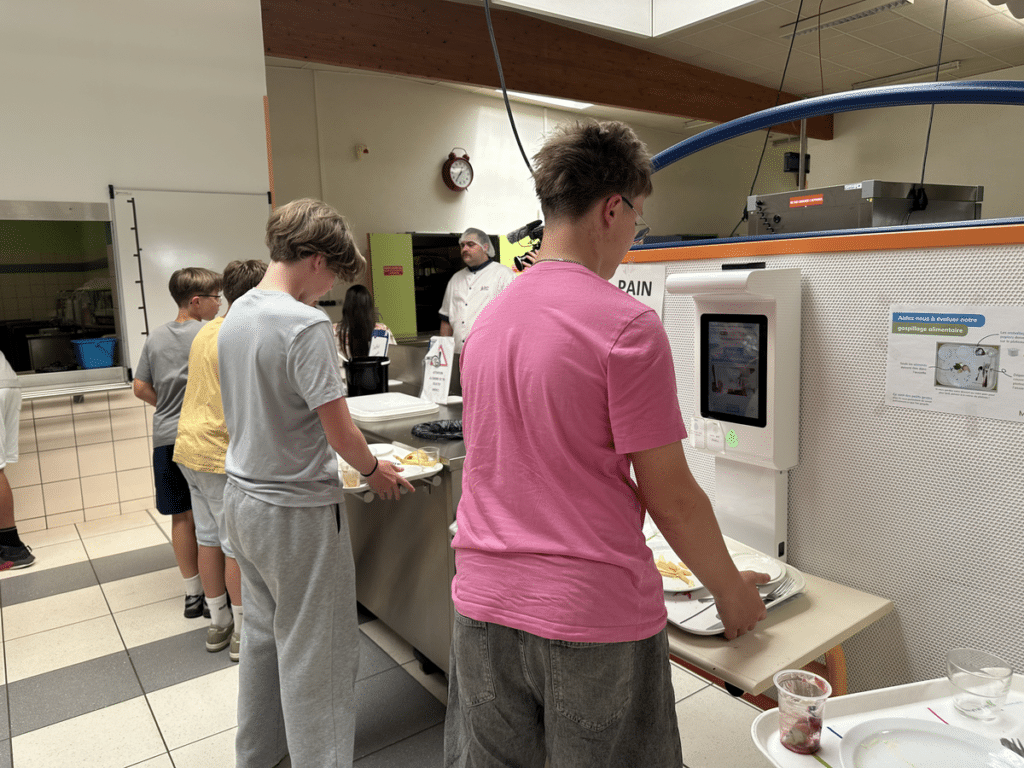
A self-service cafeteria with 480 meals per day
Paul Scarron High School accommodates approximately 480 students. The restaurant operates as a self-service cafeteria: students serve themselves, which gives them responsibility but makes it more difficult to control quantities.
The issue is also economic. The cost of a meal is far greater than the price paid by families, and each discarded plate represents a cost borne by both the community and families. Reducing waste therefore means both conserving resources and making better use of every euro invested in food.
Before Kikleo: measured waste, but not explained
The establishment was already tracking its bio-waste, but approximately: a global weighing, without distinction between types of food, nor between avoidable leftovers and unavoidable waste such as peelings or bones.
Under these conditions, it was impossible to know precisely which dishes were less popular, which portions were too generous, or where to focus efforts.
A terminal installed at the return of the trays
To take things a step further, the high school installed the Kikleo student kiosk in the dining hall, near the clearing area. The process is simple: at the end of the meal, each student places their tray in front of the kiosk. Thanks to its 3D camera, the kiosk automatically identifies and weighs the remaining food in less than a second, without altering the students' route. This has become a daily routine for high school students, like Clovis, a senior interviewed in the report.
The kiosk operates autonomously during service. The data is centralized on the Kikleo platform. Carine Drouet, the school's catering manager, can access a photo of each tray, the evolution of food waste per diner, the number of meals served, the cost of the waste, and its carbon footprint. As the journalist fromICI, this technology "allows us to go further, to see which foods are popular and which are not, and to better adapt the menus."
Results shared with students every week
Based on this data, the catering team can adjust its menus, recipes and quantities prepared according to what the students actually eat.
The results are also shared at the end of the week. It's a fun way to involve high school students, who can see the concrete effect of their actions and become active participants in the process.
A region that wants to go further
According to the report, school cafeterias in the region waste an average of 30 grams of food per student, compared to 60 grams nationally. A good result, which "can still be improved." The Regional Council, represented in the report by Gilles Ligot, regional councilor and member of the high school commission, clearly demonstrates its commitment to fighting food waste. This is precisely the aim of the measure: to identify the remaining areas for improvement, where estimates are no longer sufficient.
Making data a lever for continuous improvement
At Paul Scarron High School, the approach is based on a simple method: measure waste to obtain reliable data, analyze this data to understand which foods are being discarded, then reduce food waste through better-adapted menus and quantities.
By transforming leftover food from the trays into usable data, the school has a concrete tool to manage its catering, raise student awareness, and better showcase each meal prepared. This approach benefits students, kitchen staff, families, and the environment alike.